Wednesday, December 15, 2010

Do you know what contemporary embroidery looks like?


The first three are from a series called 'Tourists contemplating the British Museum'by Rosie James. The next two are by Alice Kettle. The second to last is called 'Ruined forest' by Karen Richard. And the last one, my personal favourite, is by Susanne Greg.
There was a fabulous exhibit at the Bibliothèque Forney in Paris in June on contemporary art and embroidery; 49 international artists selected for the « PFAFF Art Embroidery Challenge 2009 » were exhibited at the library.

Jellyfish crop circle 2009


Article found in the Telegraph:

600ft jellyfish crop circle found in Oxfordshire field

A 600ft jellyfish pattern has appeared in a barley field in Kingstone Coombes, Oxfordshire, in what is one of the most intriguing crop circles ever seen in Britain.

The vast pattern appeared in the field last week (May 2009) and experts are claiming it to be the first of its kind in the world.

Karen Alexander, a crop circle expert, said: "We have seen butterfly and bird patterns in the past, but this is the first jellyfish crop circle in the world.

"It is absolutely huge - roughly three times the size of most crop patterns and extremely interesting. People have been aghast at the size of it. It is a complete monster.

"We are looking into the meaning of it, but at present it just seems to have appeared out of nowhere."

Crop circle theorists known as 'croppies' - believe the patterns are created by UFOs during nocturnal visits, or caused by natural phenomena such as unusual forms of lightning striking the earth.

photo: Steve Alexander

Saturday, December 4, 2010

Miki Nakamura


My continuous fascination for jellyfish led me to her. Miki Nakamura makes these delicate objects in kozo, mulberry fibre paper made by hand.

Thursday, December 2, 2010

je me laisse guider par la dentelle


Armel Barraud
Alice Riehl
Sandrine Pincemaille
Aude Tahon
Marc Albert

Comme j'aurais adoré aller à la découverte de la dentelle contemporaine grâce à l'expo "Ultra Dentelles" qui a eu lieu au mois de mars à Paris aux 4 adresses d'Ateliers d'Art de France.

Ateliers d’Art de France, le premier syndicat professionnel des métiers d’art

"Fondé en 1868, Ateliers d’Art de France fédère 28 00 créateurs, artisans, artistes et manufactures d’art. Premier groupement professionnel des métiers d’art, il représente le secteur auprès des pouvoirs publics et des organismes professionnels, en France et à l’étranger. Copropriétaire de Maison&Objet et propriétaire du Salon International du Patrimoine Culturel, Ateliers d’Art de France est à la fois une structure d’accompagnement des professionnels et une structure assurant la promotion des savoir faire métiers d’art. Pour ce faire, il dispose de 4 espaces parisiens : la galerie Collection dans le Marais, les boutiques Talents de l’Opéra et de l’Etoile et l’Atelier, au Viaduc des Arts. Ateliers d’Art de France accompagne et fait connaître les métiers d’art par différentes actions. Il propose à ses adhérents des formations, des aides personnalisées et du conseil individualisé afin de les aider dans le développement de leur activité. Il soutient les jeunes professionnels en phase de démarrage de leur activité grâce à sa Pépinière d’entreprises. À l’international, Ateliers d’Art de France offre un soutien à l’export aux entreprises en leur proposant de participer à des pavillons collectifs français dans les salons majeurs du secteur en Europe, aux Etats-Unis et au Japon, sous l’égide de la marque Created in France." Corinne Jeannet pour France 2

Wednesday, December 1, 2010

qui introduit la dentelle en France?

Mariage princier, le point Colbert. Lefébure, XXème siècle.

Une initiative de Louis XIV

Pour mettre un frein au snobisme des nobles, qui ne veulent porter que des dentelles étrangères, et pour éviter la sortie ruineuse et constante de devises, Louis XIV et Colbert intègrent la dentelle dans leur projet de domination culturelle et manufacturière qui englobe la tapisserie, les tapis, la porcelaine, les glaces etc. C'est le 5 août 1665 que Louis XIV, conseillé par Colbert, crée les premières manufactures royales de dentelles dans huit villes et prend des mesures incitatives pour qu'elles se développent :
* fermeture de toutes les frontières aux dentelles étrangèes,
* transfert de savoir-faire par des dentellières vénitiennes et flamandes,
* exonération d'impôts pour les nouvelles manufactures et pour les parents qui y envoient leurs filles,
* versement de subventions aux manufactures,
* commandes de dessins à de grands artistes,
* interdiction aux nobles de porter des dentelles étrangères,
* protection et aide garanties pendant dix ans.

Mick Fouriscot, Dentelles de France, Christine Bonneton, 2005

Tuesday, November 30, 2010

ramper comme Anna Halprin et creuser comme Kazuo Shiraga

Anna Halprin, Experiment in the Environment, 1962
Exposition "Anna Halprin. A l'origine de la performance", musée d'Art contemporain de Lyon, 8 mars-14 mai 2006. Cliché Rudy Bender.


Kazuo Shiraga, Challenging Mud, octobre 1955, première exposition Gutaï, Tokyo.

"Les artistes ont un rapport oblique au paysage : ils y marchent à l'amble comme les chevaux ou latéralement comme les crabes, ils s'y enfoncent comme des taupes ou s'élèvent au-dessus de lui à la manières des buses pour planer et s'abattre sur tel détail insignifiant qui prend alors soudainement un relief insoupçonné. Les artistes rampent, roulent et déroulent leurs corps, ils grattent, creusent,caressent. Pas de deux, esquives, entrechats, tout est bon pour dire le paysage..." G.A.T.

Comme une danse, Les carnets du paysage n°13&14, Actes Sud et l'Ecole nationale supèrieure du paysage, 2007

Wednesday, November 24, 2010

Marie Hugo. Here are her marvellous buttons!

Nom illustre de l'aïeul, Victor. Marie Hugo, fille de Jean Hugo, a étudié la lithographie et la gravure à l'Ecole des beaux-arts de Montpellier. Elle travaille bientôt dans l'atelier de son père tout en commençant une recherche artistique personnelle. Depuis 1982, elle a exposé régulièrement son travail en France, mais aussi à l'étranger (Londres, Athènes, Hong Kong, Tokyo, New York).

Illustrious name of her ancestor, Victor. Marie Hugo, daughter of Jean Hugo, studied engraving and lithographic printing at the "Ecole Nationale des Beaux-arts de Montpellier". Soon after, she works in her father's studio while beginning her own artistic research. Since 1982, exhibits of her work have been held in galleries in France and abroad (London, Athens, Hong Kong, Tokyo, New York).


"Pour ce qui est des points, je distingue, selon les saisons, la pluie, la neige, le vent, le soleil. Et, selon les circonstances, l'envers, l'endroit, le Yin, le Yang. Car les points sont vivants et d'une infinie variété! Ceux qui sont gorgés d'eau, ou d'encre, mus par un seul souffle; ceux qui sont clos comme un bourgeon ou ramifiés comme tissés de fils ténus; ceux qui sont vastes et vides, secs et insipides; ceux qui hésitent entre encre et non-encre, blancs volants comme une fumée; ceux qui offrent l'apparence lisse ou transparente, ou brûlée comme de la laque. Il reste encore deux points jamais révélés: le point sans Ciel ni Terre qui tombe, fulgurant, en un éclair; le point lumineux, invisible, chargé de mystère au sein de mille rochers et de milles grottes. Ah, la vraie Règle n'a point d'Orient fixe; les points se forment au gré du Souffle!"
Shih-t'ao, célèbre peintre du début de la dynastie Ts'ing (XVIIe-XIXe)et auteur des Propos sur la peinture. Extrait de Vide et Plein, le langage pictural chinois, François Cheng, Editions du Seuil.

Texte et photos: Loïc Allio, Boutons, Seuil, 2001

Tuesday, November 23, 2010

Man with a glove by Titien


L'homme au gant, par Titien, est un exemple de l'élégance masculine au XVIeme siècle. Paris, musée du Louvre.

Man with a glove, by Titien, is an example of masculine elegance in the XVIth century. Paris, Louvre museum.

Alexandra Fau, Histoire des tissus en France, Editions Ouest-France, 2010

Monday, November 22, 2010

Il cinema neorealista ricordiamo Rosselini e De Sica


Roma citta apperta is playing at the MK2 quai de loire in Paris on Sunday 28th November at 11 am.


Even if you don't really understand Italian, I'm sure you must enjoy reading it!

La dolce vita è finita: Cinquant'anni di cinema italiano

... Tra gli autori più famosi del cinema neorealista ricordiamo Roberto Rosselini, regista di Roma città aperta (1945), un dramma-documento delle ultime tragiche fasi di liberazione del fascismo, e di Paià (1946), che tratta dello sbarco delle truppe alleate in Sicilia. Ma il film forse più amato e imitato dai registi successivi è Ladri di biciclette (1948), di Vittorio De Sica. Questo film racconta la vicenda di una famiglia che vive ai margini della società; una famiglia coinvolta in una lotta disperata per sopravivere in un mondo in cui la solidarietà umana sembra soffocata...

Lettura from my Italian text book: Habekovic and Mazzola, Insieme, an intermediate italian course, McGraw Hill, 1998.

Sunday, November 21, 2010

Giving a new life to my books ***the journey begins***

I look at my books every day, letting them rock me, guide me, educate me, influence me, inspire me, uplift me, depress me... They surround me and keep me company.
Some I have read, even reread, but many have never been opened. I just enjoy their presence.
Most of these beautiful words and photos console me on difficult days. Bring me up and keep me up. Send me off on wild journeys. Give me new ideas and keep my imagination alive.
This evening, I thought about it and came up with the idea of writing a post about each of them, to have them feed me more regularly. I will then be able to say, at least, that they have all been opened. Maybe not all read but opened and having something of interest, to me, extracted from them.

The first three books will be:
- Histoire des tissus en France by Alexandra Fau (History of fabrics in France) - PARTLY READ
- Boutons by Loïc Allio (Buttons)- BROWSED

There will be interruptions here and there when I can't stop my hands from writing about an exquisite embroidery designer, a delicate florist or a catapulting dancer.

Friday, November 19, 2010

"...révérer l'infiniment grand..." Dostoïevsky

“Ce dont l’homme a bien plus besoin que de son bonheur personnel, c’est de savoir, ainsi que de croire à tout instant, qu’il existe déjà quelque part, pour tous et pour le tout, un bonheur parfait et serein… La loi entière de l’existence humaine se résume à ce que l’homme puisse toujours révérer l’infiniment grand. Si l’on enlève aux hommes ce qui est infiniment grand, ils cesseront de vivre et mourront désespérés. L’homme a besoin de l’illimité et de l’infini tout aussi bien que de la petite planète où il habite.”


Les Possédés Fédor DOSTOÏEVSKI

Monday, November 15, 2010

wisteria to wish you a happy week!!


photo from the blog an apple a day

not quite the right season but I like the colour, it's representative of my mood today.

Friday, October 29, 2010

who wants to make garlands?


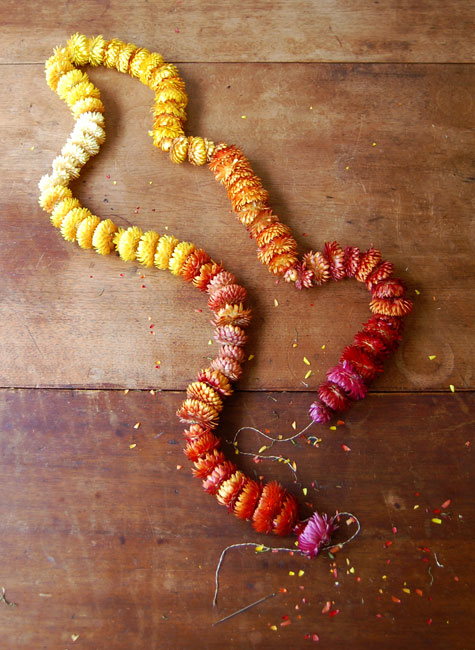
These garlands are made in San Francisco by the ladies at Studio Choo. It reminds me of being in India. When will I go back to India? I do miss it.
It's Halloween, a perfect opportunity to make garlands, is it not? Have fun!!

Friday, October 15, 2010

Festival d'Automne rhymes with Merce Cunningham


For some reason I always end up choosing a choreography by Merce Cunningham during the Festival d'Automne in Paris. Is it the element of chance?
This year I get to see three in one evening: Pond Way (1998) with the decor by Roy Lichtenstein and the music by Brian Eno, Second Hand (1970) with the music by John Cage and Antic Meet (1958) with the decor by Robert Rauschenberg and the music by John Cage .
Merce Cunningham must be the most celebrated contemporary choreographer to this day.
He was known for continuously expanding the boundaries of dance through his experimental methods, such as injecting an element of chance to his performance and elaborating a computer software to help with the asymmetrical patterns and the spatial structure.
Could I be lucky enough to see the Roaratorio (1983) inspired by Joyce's 'Finnegans Wake'? It will be showing at the Théâtre de la Ville mid-November.
second photo courtesy of Anna Finke

Monday, October 11, 2010

read between the fluorescent pink


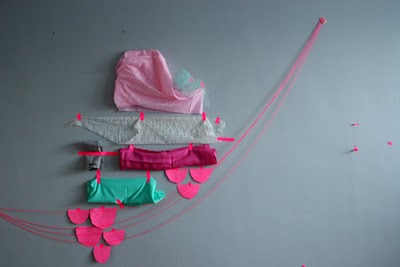
Esther Ramirez - designer of Essimar papel - makes funky installations, jewellery, cards and animal sculptures with colourful paper. What I love the most is her use of fluorescent colours, especially the pink, pink, pink. Just have to love pink. She sells her creations on the etsy site.

my secret love affair with flowers ... no longer so secret


First three photos taken from the 'Bloom' website and the last one found on the viet anemi blog.